

Crystallisation
Concrete becomes waterproof from within: crystals grow in the pores and capillaries, and re-form every time water finds a new path.
The mechanism
Crystalline products contain active ingredients that react with the moisture and with the free lime present in the cementitious matrix. The reaction generates insoluble crystals that progressively occupy pores and capillaries, reducing capillary absorption and the permeability of the mass.
The distinctive property is that the reaction is dormant. In the absence of water the active ingredients stay inert; when water reappears — even years later, even at a different point — crystallisation resumes. This is what produces the self-healing of cracks, declared by manufacturers up to 0.4 mm for straight cracks and 0.5 mm for branched ones.
In the mass or on the surface
The admixture is dosed at the batching plant, as a percentage of cement weight, and waterproofs the entire volume of the pour. This is the route for new structures: no layer to apply, no surface to prepare, no risk of site damage.
The penetrating slurry, instead, is applied to the surface of concrete already in place: the active ingredients migrate into the matrix by diffusion. This is the renovation route, and it also works against negative pressure.
The variants available
Commercial products combine crystallisation with a second function. The version with an integrated corrosion inhibitor actively protects the reinforcement, useful in aggressive or marine environments. The hydrophobic version adds an immediate reduction in water absorption, which precedes crystal formation. The plasticising version, classified under EN 934-2:T2, allows a reduction of mixing water and therefore a direct improvement in durability.
They come in powder form, including water-soluble bags that go whole into the mixer, and in liquid form for automatic dosing at the plant.
What it does not do
Crystallisation makes the mass of the concrete waterproof. It does not seal construction joints, which are interfaces between two pours and must be treated with waterstops; it does not close cracks wider than the declared value; it does not replace structural design aimed at limiting cracking. A complete system uses crystallisation as the base and waterstops as the complement.
Products for this system
Selected from the Probar 2026 catalogue for this application.
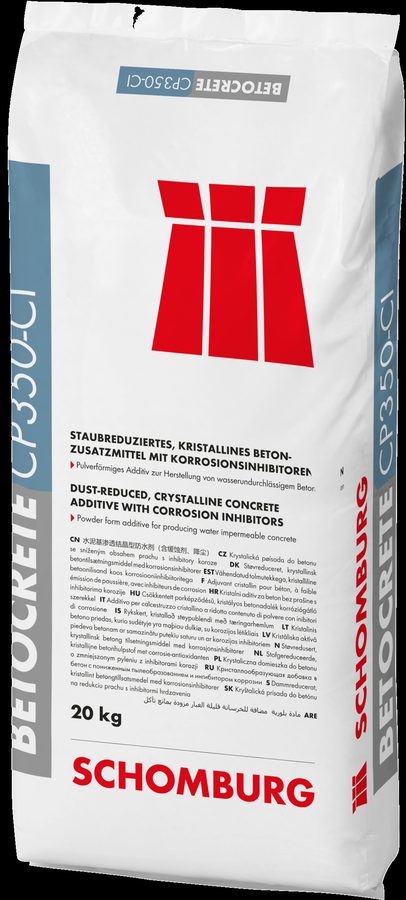 BETOCRETE-CP350-CIPowder waterproofing admixture with crystalline technology and anti-corrosion actionConcrete admixturesArt. 206456Schomburg
 BETOCRETE-CP360-WPPowder waterproofing admixture with crystalline technology and hydrophobic propertiesConcrete admixturesArt. 206446Schomburg
 BETOCRETE-CL170-PLiquid waterproofing admixture with crystalline technology and plasticising propertiesConcrete admixturesArt. 206443Schomburg
 BETOCRETE-CL210-WPLiquid waterproofing admixture with crystalline technology and hydrophobic propertiesConcrete admixturesArt. 206444Schomburg
 AQUAFIN-ICMineral crystalline slurry — permanent structural waterproofingWaterproof slurries and mortars—Schomburg
Frequently asked questions
What is the dosage of a crystalline admixture?
It is expressed as a percentage of cement weight and varies with the water/cement ratio: roughly 0.75% to 0.95% for powder products and 1.75% to 2.00% for liquids. The binding figure is on the individual product's data sheet.
Does crystallisation also work from the inside, against negative pressure?
Yes: this is one of its distinctive features compared with film-forming coatings, which under negative pressure get pushed off by the pressure. Crystals form inside the matrix, so there is no interface that can fail.
Can crystallised concrete still breathe?
Yes. The occlusion concerns capillaries carrying liquid water, while vapour permeability is substantially preserved.
Continue reading
Injections
A crack conducting water is treated in two stages with two different resins. Confusing the…
Osmotic slurries
Mineral coatings that work by adhering to the substrate, compatible with concrete because …
Fibres for concrete
They do not replace reinforcement. They control plastic-shrinkage cracking, which is a dif…