

Fibres for concrete
They do not replace reinforcement. They control plastic-shrinkage cracking, which is a different phenomenon and starts within the first hours of a pour's life.
What they actually do
In the first hours after casting, water evaporates from the surface faster than it rises from below. The result is differential shrinkage that generates micro-cracks, through which water and aggressive agents will later enter.
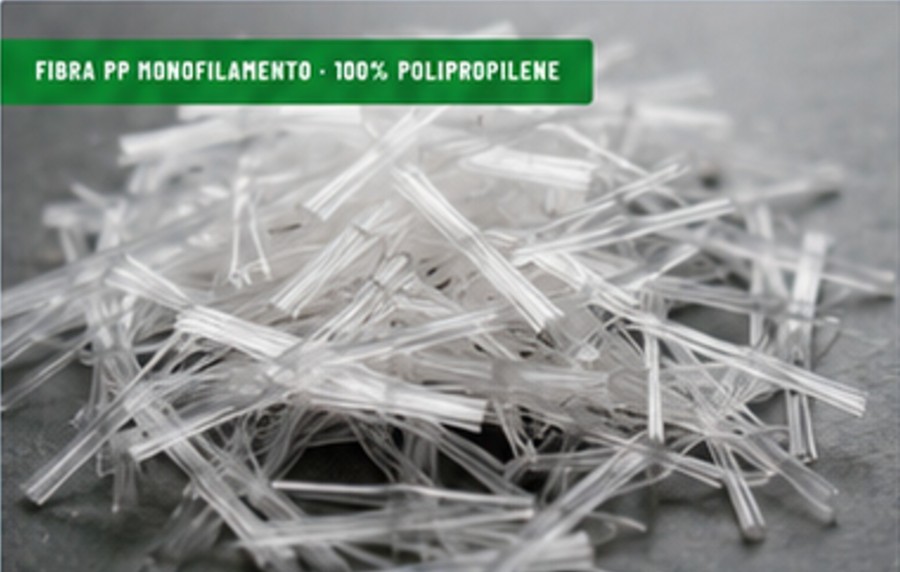
Monofilament fibres distributed through the mass counteract this with an isotropic three-dimensional effect: they intercept micro-cracks as they form and stop them spreading. The benefit to durability is indirect but substantial — concrete with fewer micro-cracks absorbs less water.
How to choose them
Length determines the field of use: 3 and 6 mm for mortars, renders and chemical products, 12 and 18 mm for structural concrete, shotcrete and industrial flooring. The circular section and 100% virgin polypropylene monofilament ensure uniform dispersion and compatibility with the cementitious matrix.
The reference standard is EN 14889-2 for synthetic fibres, with type classification. Typical dosages are in the order of a few hundred grams per cubic metre.
Products for this system
Selected from the Probar 2026 catalogue for this application.
Frequently asked questions
Do fibres replace welded mesh reinforcement?
No, not in its structural role. Synthetic fibres at these dosages control plastic-shrinkage cracking; replacing reinforcement requires structural fibres and a specific design check.
Do fibres show on the surface?
With correct dosages and proper finishing, surfacing is minimal. On fair-faced concrete a test patch is still advisable.
Continue reading
Crystallisation
Concrete becomes waterproof from within: crystals grow in the pores and capillaries, and r…
Injections
A crack conducting water is treated in two stages with two different resins. Confusing the…
Osmotic slurries
Mineral coatings that work by adhering to the substrate, compatible with concrete because …