

Bentonite geocomposites
A blanket of sodium bentonite between soil and concrete: on contact with water it swells, seals and closes up again by itself.
In this sectionSodium bentonite geocomposites: self-bonding to the concrete or combined with an HDPE membrane.
Values declared in the product data sheets (Probar Italia 2026 catalogue and Schomburg technical data sheets). For complete and up-to-date values, the manufacturer's data sheet prevails.
The principle: active waterproofing
The geocomposite encloses natural sodium bentonite between two geotextiles. When groundwater reaches the sheet, the bentonite hydrates and swells: confined between soil and structure, it forms a very low-permeability layer that self-seals at overlaps and around small discontinuities. It is an active system: it reacts to water instead of merely standing in its way.
Two versions, two needs
BGC GRIP has granular bentonite enclosed between a woven and a non-woven geotextile. Its self-anchoring structure bonds mechanically to the concrete poured against the sheet: the choice for foundations, underground car parks, metro stations, cut-and-cover tunnels, tanks and structures below the water table. It is CE marked to EN 13491 (GBR-C, system 2+).
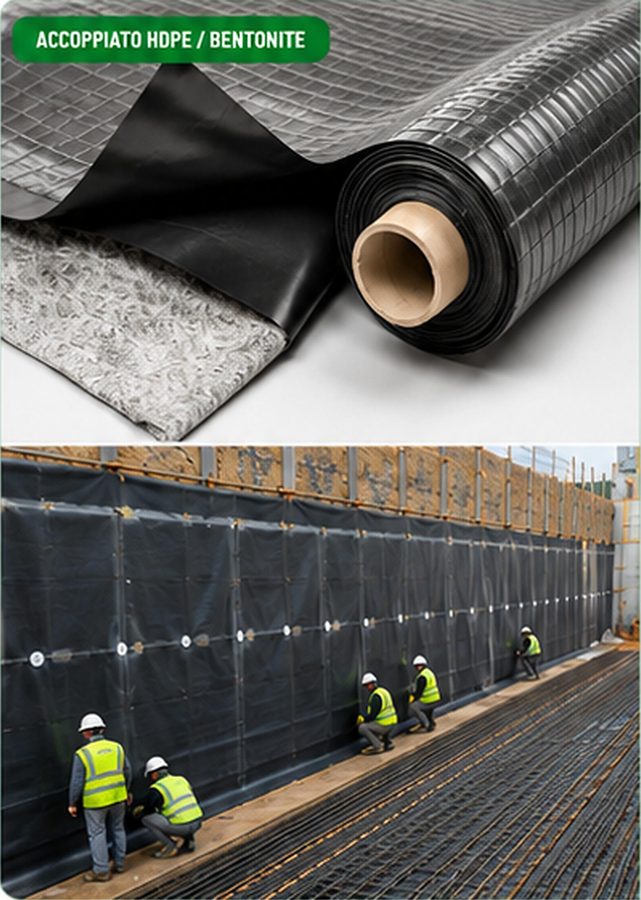
BGC HDPE laminates the geocomposite to an HDPE membrane, for active waterproofing of underground structures and structures in groundwater, including water reservoirs. Overlaps from 5 to 10 cm.
Where it is applied
The sheet is laid on the blinding beneath the slab and against sheet piles or formwork before the walls are poured, always on the water side. For the bentonite to work it must be confined: the concrete pour, or compacted backfill, provides the pressure that keeps it in place.
What it does not do
The geocomposite protects continuous surfaces; it does not replace the treatment of construction joints and singular points, which must be solved with dedicated waterstops (for example PRO WS bentonite profiles). It is not designed to remain exposed or unconfined: it must be installed and protected as indicated in the data sheet.
Products for this system
Selected from the Probar 2026 catalogue for this technology.

Brochures to download
Technical and commercial documentation for this technology.
Where it is used
The solutions for which the products of this technology are listed in the catalogue.
Frequently asked questions
Is the geocomposite laid before or after pouring?
Under the slab and against sheet piles or formwork it is laid before pouring, so that the concrete is poured directly against the sheet: with BGC GRIP this creates the mechanical bond to the concrete.
What is the difference between BGC GRIP and BGC HDPE?
BGC GRIP has bentonite between two geotextiles and a self-anchoring structure that bonds mechanically to the pour. BGC HDPE adds an HDPE membrane laminated to the geocomposite. Both are CE marked to EN 13491.
Which formats are available?
BGC GRIP comes in 2.5 × 20 m rolls (about 270 kg) and 1.2 × 5 m rolls (about 32 kg); BGC HDPE also in the small 1.2 × 5 m format (about 27 kg).